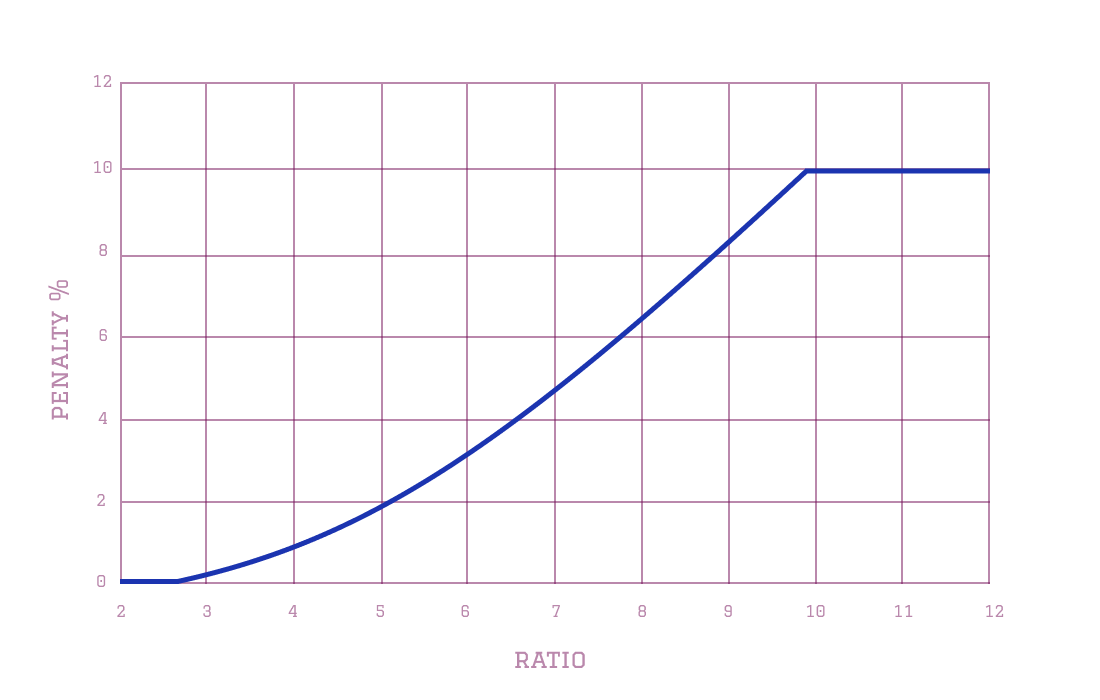
So the penalty curve looks like this:
Design questions
Why is the basic fee 0.1%?
This hook is built for low-liquidity pools — launchpads, meme coins, creator tokens. 0.1% is roughly the market standard there; go lower and LPs stop earning enough to bother providing liquidity.
Why does the penalty start only from 2.7x?
I didn’t want to punish real users. Even people who pick “fast” in their wallet rarely go above ~3x the typical priority fee. So the curve starts at 2.7x — the penalty only really kicks in once you’re past what a normal user would ever pay.
Why is the cap 10%?
Sandwich attacks need two transactions, so a 10% cap becomes ~20% across the attack — more than enough to kill the profit. I capped it rather than let it grow uncapped so a swap can never eat a user’s (or bot’s) entire amount. It’s the sweet spot between real deterrence and not being punitive.
The formula
The curve is computed on-chain with the formula below, using OpenZeppelin’sMath library.
Why frac^1.5 and not a “real” power function
Solidity has no cheap general pow for fractional exponents. But frac^1.5 can be rewritten as:
sqrt is cheap on-chain via Math.sqrt. So the whole curve costs one multiplication and one integer square root, with no fixed-point ln / exp / pow library needed.
Constants
Formula → code mapping
How this looks in the code
All fixed-point math here uses two scales:PRECISION = 1000 for the ratio (so 2700 means “2.7x”), and WAD = 1e18 for the fractional-exponent part.
Notes
M(reference median) is a smoothed value, not the live running median directly — see Priority Fee Median for how it’s derived.- Edge case: if
referenceMedian <= 0(no data yet),_getDynamicFeereturnsBASIC_FEEdirectly, skipping the ratio/penalty calculation to avoid division by zero.
Key takeaway
- Every swap pays a flat 0.1% baseline.
- Nothing extra is charged until the priority fee is 2.7x the reference median.
- Above that, a smooth
frac^1.5curve adds up to 10% more, saturating at 10x. - The whole thing is computed with one multiplication and one
Math.sqrt, cheap enough to run on every swap.